Contact

PMD

We believe that there is a future where 0% residual waste is the standard. Many high-quality raw materials are still being burned unnecessarily, and we want to do something about that together with you!

The way we do this is by making it easy for companies to separate waste and then having it collected in a separated and sustainable manner.
This way, we achieve an 81% raw material gain compared to residual waste!

Download poster ENG


What happens to my PMD?

Approximately 80 to 90% of the PMD we collect is recycled into raw materials for the production of new products or packaging. The remaining portion consists of plastics that cannot be recycled.

At the processing facility, the plastic and drink cartons are separated. Drink cartons consist of laminated cardboard. The cardboard is separated from the plastic layer. The cardboard is then used as a raw material in the paper industry, and the plastic is reused to produce plastic packaging. Plastic packaging is sorted by type. Lower-grade material is processed into agglomerate, while higher-grade plastic is turned into regranulate. Both forms are suitable for use in new plastic applications. Around 10% of the collected plastic is not recyclable.

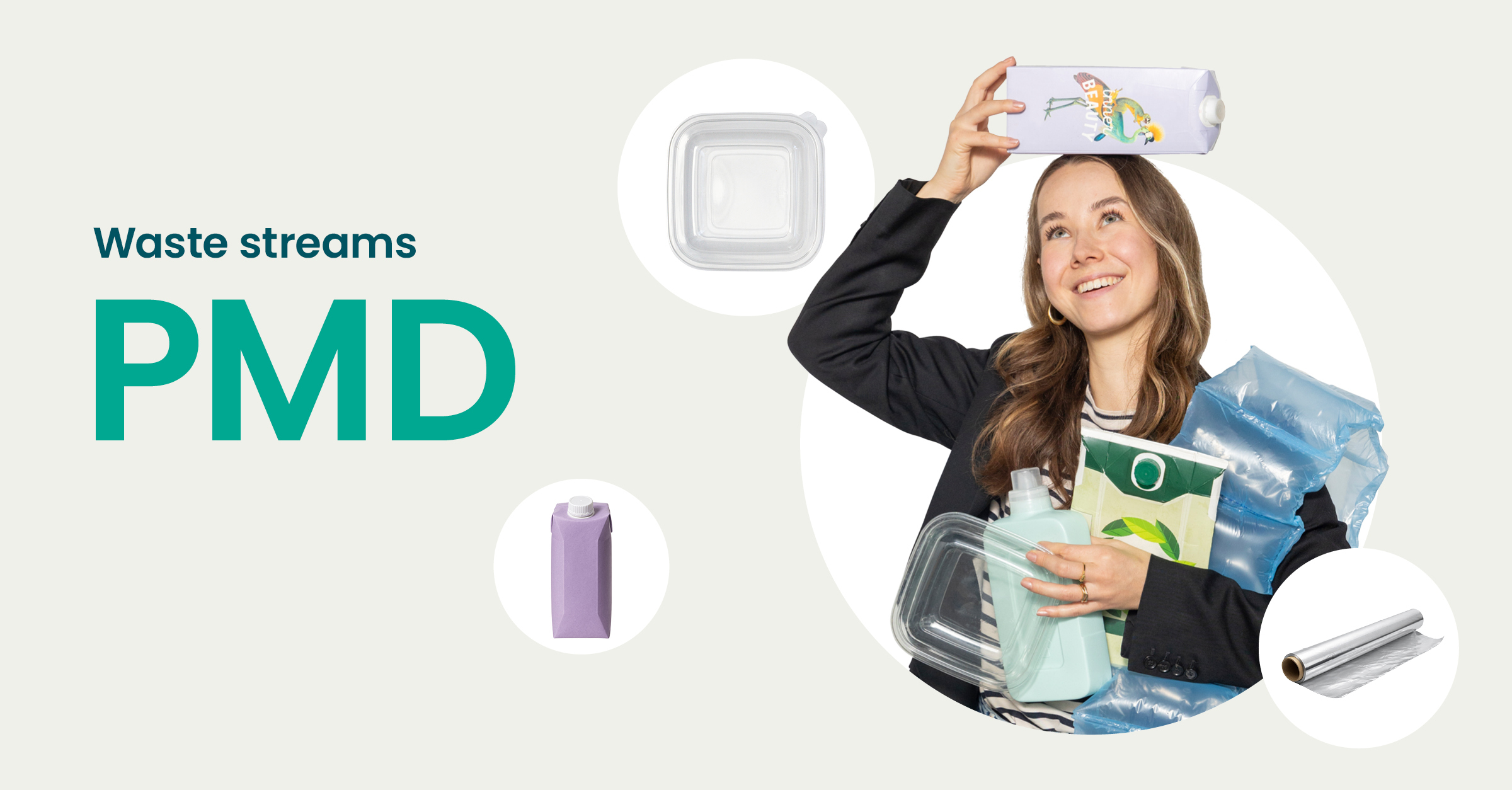
Accepted

  • Plastic packaging (e.g. bottles, cups, trays, squeeze bottles, shampoo bottles, containers, bags, and food tubs)

  • Drink cartons made of cardboard/PE or cardboard/aluminium/PE

  • Used, scraped-empty plastic packaging and drink cartons with contents < 5 litres and length < 75 cm (approx. A4 size)

  • Metal packaging and aluminium foil

  • Metal food tins

  • Metal aerosol cans for deodorant and hairspray (excluding aerosol cans with hazard symbols)

  • Blister packs for chewing gum and medicines

  • Coffee capsules

  • Caps, crown corcks, and lids

  • Chip bags


Not accepted

  • Packaging containing residual contents or filled with other materials
  • Chemical waste or chemical packaging (hazard symbols, bottles with child-proof caps)
  • Hard plastics
  • Paint cans
  • Caulking tubes
  • Styrofoam and foam packaging
  • Batteries and accumulators
  • Agricultural plastics or pond liners
  • Bulky waste and household items (e.g. buckets, toys, drying racks, etc.)
  • Non-PD materials such as stones, rubber, paper, cardboard, glass, textiles, wood, hygiene products, electronic devices, and organic waste (e.g. food and garden waste)


  •  

Want to motivate your employees and/or customers to sort PMD properly?

Download our posters!


Download poster ENG