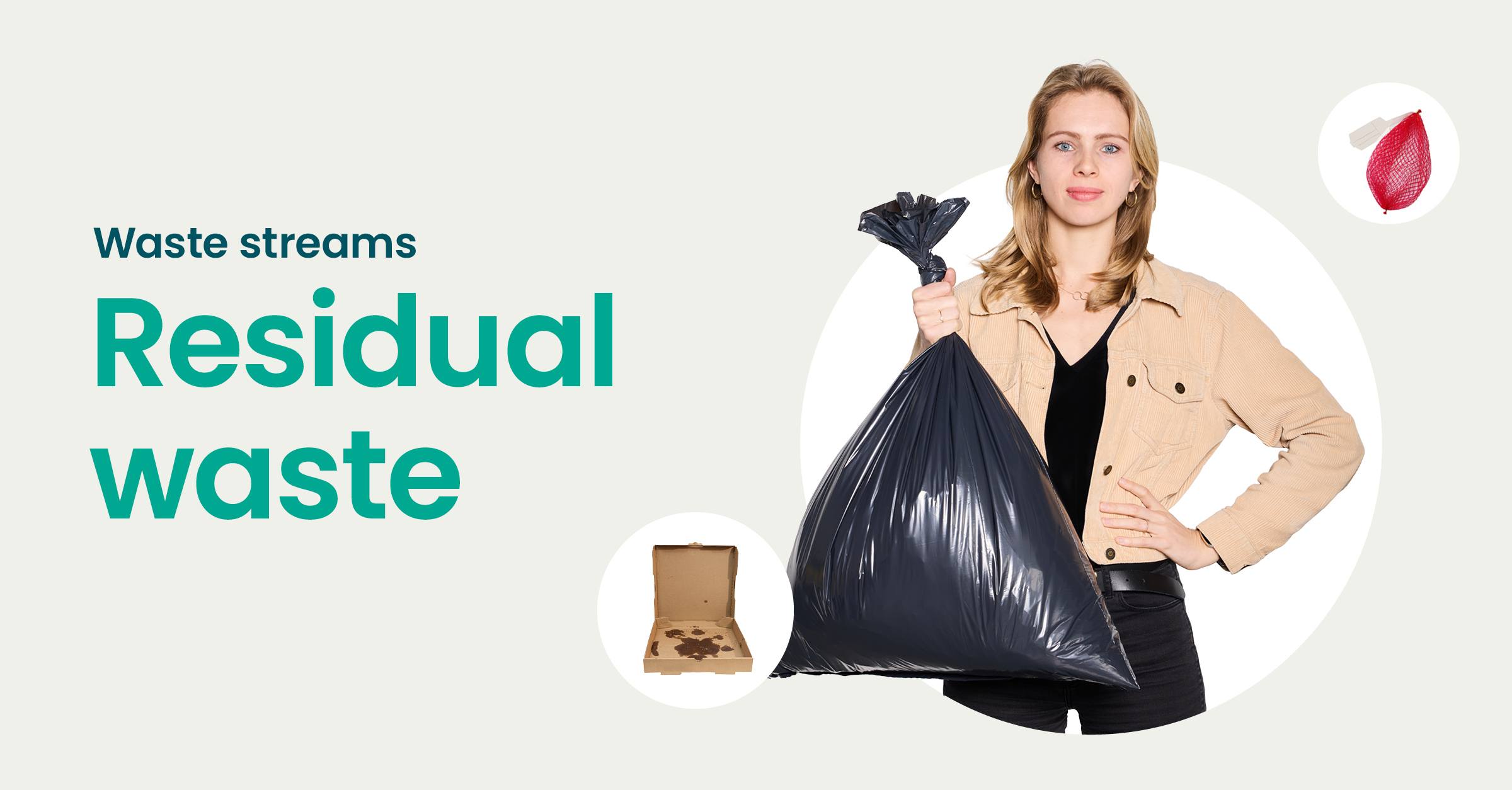
By separating waste correctly, only a minimal amount of residual waste remains. Separated streams can be processed circularly into new products. We also help you eliminate non-recyclable waste, with the potential to lower residual waste to around 5%. Working with us means fewer collections, more flexibility and lower CO₂ emissions.
What happens to my residual waste (also general waste) after I throw it in the bin?
Our goal is to generate as little residual waste as possible. Why? Residual waste is incinerated, which causes valuable raw materials to be lost. The heat released can be used for district heating, but due to the high CO₂ emissions, this is not considered a sustainable energy source. It is therefore classified as grey energy.
Accepted
Non-recyclable but combustible waste
Waste fractions with maximum dimensions of 30 × 30 × 60 cm (fits in standard waste bags)
Office and canteen waste
Contaminated paper (such as pizza delivery boxes)
Tape and adhesive materials
Cleaning cloths
Not accepted
Insulation materials (such as glass wool, stone wool and polystyrene)
Technically non-combustible or non-processable materials (such as agricultural film, cables, big bags, straps, sofas, root fabric, bundled paper or film)
Asbestos-containing or asbestos-like materials (such as corrugated sheets)
Liquids, liquid waste and pasty substances
Vehicle tyres
Mattresses
Baled, bundled or compacted waste
Electronic waste and white and brown goods
Radioactive waste
Strong-smelling waste
Explosive substances
Aerosol cans, gas cylinders and pressurised containers
Want to motivate your employees and/or customers to separate residual waste correctly?